Questions by Rich Vibert
Answers by 内田海宇 Myu
Introduction
Washi is Japanese paper. It’s made carefully from the inner bark of trees and plants and the resulting paper is remarkably strong, flexible, and durable. In Japan, it has been used for hundreds of years in calligraphy, printmaking, bookbinding, lanterns, umbrellas, clothing, and many other forms of making.
Japan’s abundance of fibrous plants, soft water, and humid climate gave papermaking a natural home when it arrived in the seventh century from other parts of Asia. Demand from Buddhist institutions, government, artists, and architecture carried washi far beyond its use as a surface for writing and it has since become a material woven into many aspects of Japanese life.
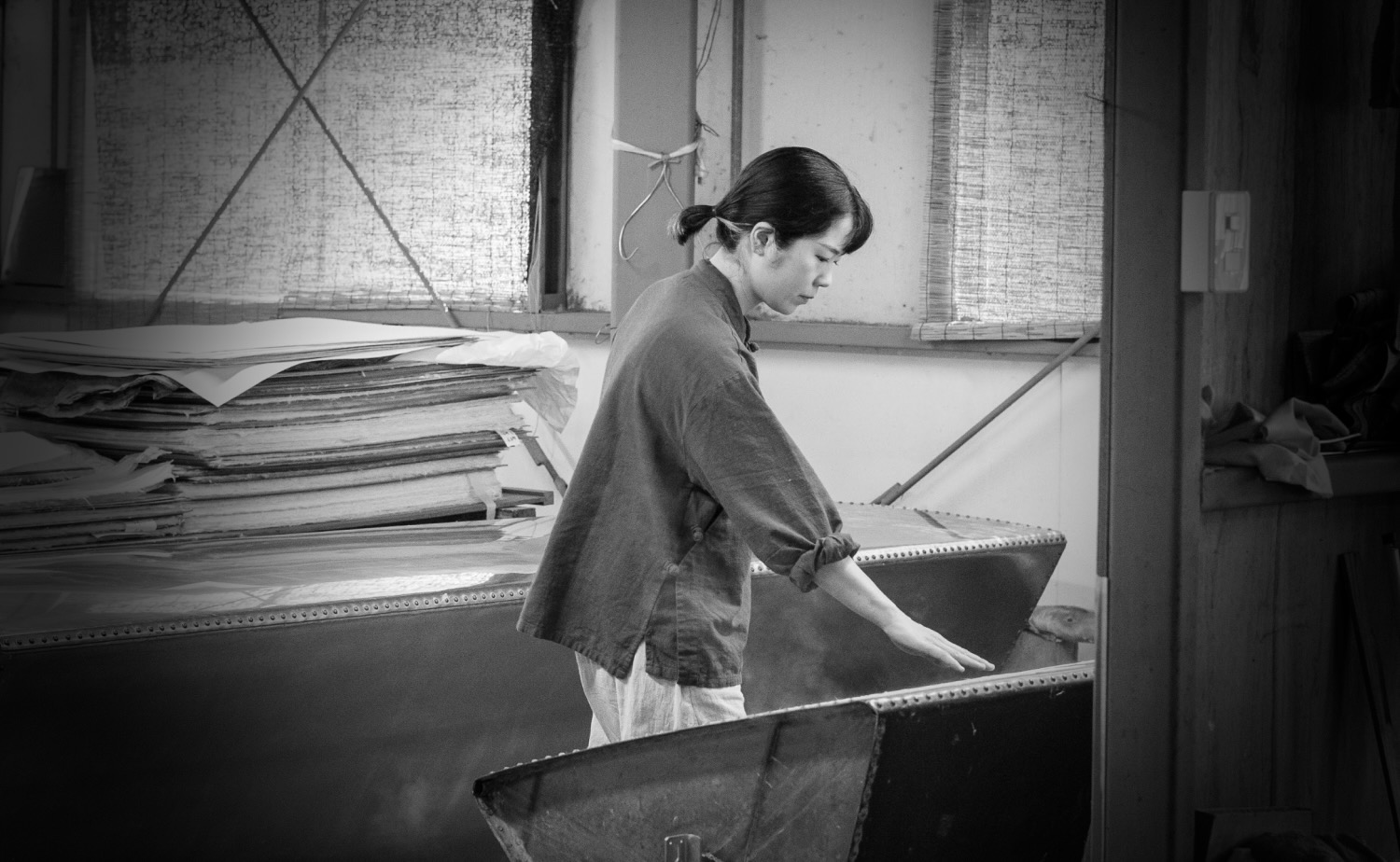
I met Myu in Kōchi, where we stayed in her home with her and her husband. Early one morning, I saw Myu mindfully cleaning long fibres of bark in a large basin of water. We talked briefly about her craft and her passion and attention to detail was wonderful to experience.
It’s a privalage to speak further with Myu and go a level deeper and learn how she came into the craft, what she has learned since starting, and her motivation to continue making for others while developing an artistic practice of her own.
This interview was conducted in writing. Questions were asked in English, and Myu replied in Japanese. Her responses have been translated into English and lightly edited for clarity, with Myu's permission. The original Japanese appears beneath each answer.
How did you first become interested in making washi?
I was born and raised in Tokyo, but the way of living in the city never quite felt right to me, and I had always been thinking about how I wanted to live my life. Around the time I graduated from university, I stayed at an organic farm in Aichi, and there I felt again that a life closer to nature suited me. I was interested in working with my hands, so while searching for something at the intersection of “nature, daily life, and making things,” washi intuitively struck me as something I should try.
Read original Japanese
東京で生まれ育ったけれど、都会の暮らしのあり方がしっくりこなくて生き方・暮らし方についてずっと考えていました。大学卒業と同時に滞在した愛知の有機農家で、やはり自分には自然が近い暮らしがあっていると感じました。手仕事に興味があったので、「自然、暮らし、ものづくり」の交点を探す中で、和紙が直感でピンときてやってみようと思いました。
What are the different types of washi?
Actually, there is no clear definition of “washi.” It is a word that is often used based more on an image or impression. For example, paper made from the same conifer pulp used for Western-style paper is sometimes called washi, and in Europe I have even seen masking tape being sold as “washi.”
The word “washi” came into existence in the Meiji period, in the 1870s, when paper from the West — yōshi, or Western paper — entered Japan, and the term was created in order to distinguish Japanese paper from it. Before that, I think all paper was what we would now call washi.
So, personally, I think paper that is made in Japan using the same raw materials as were used before Western paper arrived could still be called washi. But because there is no overall definition, rather than using the word “washi” indiscriminately, I feel that naming the paper after the plant — such as “kōzo paper” or “gampi paper” — creates less misunderstanding for the person using it. I try to describe my paper in that way.
Read original Japanese
和紙というのは、実は明確な定義がなくて、イメージが先行して使われている言葉です。たとえば洋紙と同じ針葉樹パルプで作られた紙も和紙と呼ばれていたり、ヨーロッパでは、マスキングテープですら、和紙と言って売られているのを見かけました。 和紙というのは、明治時代(1870年代)に西洋からの紙(洋紙)が入ってきて、それと区別するために生まれた言葉です。それまでは、すべての紙は、今で言う和紙だったと思います。なので、私自身の中では、洋紙が入ってくる前と同じ原料で、日本で作られた紙は今でも和紙と呼べるのかなと思いますが、全体の定義がない中でむやみに和紙という言葉を使うよりは、「こうぞ紙」「ガンピ紙」と言ったように、植物名で紙の名前をつける方が、使う人に誤解がないように思い、そういうふう表記するように心がけています。
When we stayed with you, you mentioned a plant that is difficult to find and that only people who know the mountains well tend to know where it grows. Do you remember what plant you were referring to?
I think you may be referring to a plant called gampi. Gampi is said to be difficult to cultivate because it requires a particular type of soil, and it can die if it receives too much sunlight or too much fertilizer. It also grows very slowly, taking many years to become thick enough to use for papermaking. Because it grows slowly, and because people who know the mountains well are often the ones who know where it grows and gather wild gampi from there, it is considered a valuable material.
That said, in the last few years I have heard of some successful attempts to cultivate gampi, so it does not seem to be impossible to grow.
Read original Japanese
多分、ガンピという植物のことではないでしょうか。ガンピは、栽培に適した土質があるのと、日が当たりすぎたり、肥料をあげすぎたりすると枯れてしまうため、栽培するのが難しいと言われています。また、成長がとても遅くて、紙にするのに十分な太さまで成長するのに何年もかかります。 成長が遅いのと、山をよく知っているような人がどこに生えているのか把握していて山から野生のガンピをとってきているので、貴重だと言われています。 ただ、ここ数年で、ガンピを栽培しようと試みていて成功し始めているケースも耳にするので、栽培は不可能、ということではなさそうです。
How did you learn the craft? How much is learning from someone else versus learning by yourself?
I think practical experience is very important in papermaking. I read books but more of what I have learned has come through things passed down by experienced papermakers and things they have taught me directly. Then I try for myself the things I have learned and the ideas I have, and through making mistakes, I acquire my own skills. I think learning from someone else and learning by yourself are both equally important.
Read original Japanese
紙づくりは、実践がとても大事だと思います。インプットは、書籍も読みますが、先輩の紙漉き職人からの口伝や直接教えてもらったことのほうが多いです。そして、インプットしたことやアイデアを自分で実践してみて、失敗もしながら、自分の技術として体得していきます。誰かから学ぶことと、自分で学ぶこと、両方同じくらい大事だと思います。
When you started making washi, what was it that you loved so much that you wanted to do more? Is it still the same motivation today?
When I decided to begin, what attracted me was that it was a form of making things directly connected to nature. I still feel that attraction, but I have also come to feel the depth of the fact that completely different papers can be made depending on, for example, which plant you use, how you boil, beat and process that plant, and how you form the paper. It is like research in which nature is your counterpart. I am happy when, through accumulating knowledge and experience of many kinds of paper in this way, I am able to respond to the paper or expression that the person using it is looking for.
Read original Japanese
はじめようと思った時には、ダイレクトに自然とつながりのあるものづくりであるということが魅力的で始めました。やっていく中でもその魅力は感じ続けていますが、続ける中で、たとえば、どの植物を使うのかや、その植物をどのように煮たり、叩いたり、処理をするのか、どう漉くのかなどによって全然違う紙ができるということが奥深いと感じてます。自然を相手にした研究のようです。 そして、自分がそうやって色々な紙の知識と経験を蓄積していき、使い手が求める紙や、表現に応えられる時嬉しいです。
Can you give an example of two different ways people use your paper, and how your choice of materials or process changes depending on the purpose?
For example, consider paper made for calligraphy and paper made for ukiyo-e (traditional Japanese woodblock prints). For calligraphy paper, I use mitsumata (a plant with relatively short fibres) and boil it with slaked lime (a mild alkaline material). Because mitsumata fibres are shorter than kōzo fibres (longer and more durable), the surface of the paper is less likely to become fuzzy, which allows the brush to move smoothly. Boiling the fibres with slaked lime also produces a softer paper and helps the ink spread in a pleasing way.
For ukiyo-e, the paper needs to withstand being printed many times, so it has to be stronger. For this I use kōzo and boil it with soda ash (another alkaline material used in papermaking). Compared with slaked lime, soda ash produces paper that is somewhat harder and whiter. Paper boiled with slaked lime tends to have a slightly natural, off-white colour. For ukiyo-e, where the colours of the print need to stand out clearly, a whiter paper is often preferred.
So the raw material and the alkaline substance used to process it are chosen according to the qualities the finished paper needs.
Of course, even something described as “calligraphy paper” might also be made from kōzo or another plant. The choice changes depending on the kind of expression or qualities the person using the paper is looking for.
Read original Japanese
例えば書道(calligraphy)に使われる紙と、浮世絵の刷りに使われる紙を考えてみます。書道の紙は、みつまたという植物を原料にして、それを消石灰で煮ます。浮世絵の紙は、楮という植物をソーダ灰で煮ます。書道にみつまたを使うのは、楮よりも繊維が短いため紙の表面が毛羽立ちにくく筆運びがいいからで、消石灰で煮るのは柔らかい紙質で墨の滲み方が良いからです。浮世絵の場合は、何度も刷る作業があり、それに耐える強度のある紙が求められるので、より繊維が長くて丈夫な楮を使います。ソーダ灰で煮ると、消石灰で煮たときよりも硬さと白さのある紙になります。消石灰で煮ると少し生成色の紙になるので、色を魅せたい浮世絵の場合は紙自体は白い方が好まれます。 このように、紙に求められる要素によって、原料や煮るときのアルカリを選択しています。もちろん、書道の紙、といっても楮や他の植物を使うこともあります。それは、使う人がどのような表現や要素を求めているかに合わせて変えていくので、これはほんの一例です。 (他にも要素はたくさんありますが書きすぎるとわけがわからなくなりそうなので一部の例として書いてみました。)
What are some of the decisions - big or small - in the process of making washi that can have the greatest effect on the finished paper?
I think the most important thing is the mindset of sincerely trying to make good paper. I think that influences each of the small decisions — such as what kind of raw material or processing method to choose — and ultimately influences the finished paper.
Read original Japanese
一番は、誠実で良い紙を作ろう、というマインドセットだと思います。それが、どのような原料、処理を選ぶのかという一つ一つの小さな決断に影響し、最終的な紙に影響していると思います。
There must be some decisions you have to make quite often, but are there any decisions you have to make “in the moment” because something is different that you weren’t expecting?
Yes. Because I am working with plants, and they are never exactly the same each time. Of course there are things that I have to decide after I have already started working. For example, kōzo is mainly used as a raw material for washi. Even with the same kōzo, the hardness of the fibres can differ depending on the year and the place where it was harvested. There are processes where the fibres are boiled and beaten in order to soften them, and I sometimes decide how long to do those processes while observing the condition of the kōzo at that particular time.
Read original Japanese
はい、植物が相手で、毎回全く同じということはないので、やり始めてから決断しないといけないことはもちろん起こります。たとえば、和紙の原料に主に使われる楮という植物がありますが、同じ楮でも、採れた年や場所によって繊維の硬さが違ったりします。繊維を柔らかくするために煮る工程や、叩く工程がありますが、その長さは、その時の楮の様子を見ながら決めたりします。
What defines the differences between individual washi makers? What choices does each washi maker have to make that leads to their individual identity?
I think what a person makes reflects who they are, and the mindset and attitude they bring to papermaking directly influences the kind of paper they make. For example, even in farming, what a person places importance on and their view of life can create the difference between a conventional farmer and an organic farmer. Rather than the choices a person makes during the papermaking process, I think what kind of heart that person has, and how they approach their work, influences the choices and decisions they make within papermaking.
Read original Japanese
作るものは、その人の在り方を映し出していて、その人がどのような心で紙づくりと向き合っているのかは、その人がどのような紙を作るのかに直結すると思います。たとえば農業であっても、その人が何に重きを置いているかや人生観が、慣行農家と有機農家の違いを生むようのも同じことだと思います。紙の工程でどのような選択をするかがその人の個性を生むというよりは、その人がどういう心の持ち主か、どのように仕事に向き合っているのかが、紙づくりの中の選択、決断に影響していると思います。
“What kind of heart that person has, and how they approach their work, influences the choices and decisions they make within papermaking.”
What makes your own washi recognisably yours? Has that changed over the years and do you think it’ll continue to change?
For myself, I can recognise my own paper because when I look at it, the memory of making it is there. Because the memory of making it remains there, I can tell by feeling. People often look at my paper and tell me “Myu’s paper has delicacy and dignity.”
When I make paper, I try to keep my heart sincere, and to carry out the processing and papermaking carefully. If that is appearing in the paper, I would be happy. If the fundamental state of my heart does not change from now on, I think those characteristics will not change either.
Read original Japanese
自分では、自分の紙は私の紙を見たらそこには作った記憶があるので、認識できます。そこには、作った記憶が残っているから、感覚でわかります。人が私の紙をみてよく「海宇の紙は繊細さと品がある」と言ってくれます。紙を作る時には、心は誠実に、処理や紙漉きを丁寧に、行うことを心がけています。それが紙に表れているのだとしたら嬉しいことです。これからも根底の心持ちが変わらなければ、その特徴も変わらないと思います。
You said that the memory of making the paper remains. What is that memory of for you?
The memories are different depending on the paper.
Sometimes I remember the thought process — for example, noticing something that did not go well this time and thinking about what I should do differently next time. Other papers I remember together with the feeling of happiness I had when I looked at the finished sheet and thought, “That came out well.”
There are also physical memories. For example, I might remember making paper from early in the morning during winter, when the water was so cold that my hands became stiff and numb.
Read original Japanese
紙によって想い出は違います。例えば、今回うまくいかなかったところを次はこうしようと考えたという思考を覚えていることもあるし、出来上がりの紙を見てうまくできたなと嬉しかった感情と共に覚えているものもあります。冬場の寒い早朝から漉いて、手がかじかむほど水が冷たいときだったな、といった身体的な記憶もあります。
“I might remember making paper from early in the morning during winter, when the water was so cold that my hands became stiff and numb.”
In an Instagram post, you wrote: “The differences come from which part of kōzo bark I use, how I process kōzo, etc. … Infinit world.” Could you explain what you meant by “infinit world”?
Even though we simply say “washi,” the paper becomes different depending on the plant that is used and the way it is processed. Among all of these different elements, a great deal of experience and knowledge is necessary in order to become able to make the paper or expression you imagine. What I meant is that it is a deep world with no end to its pursuit.
Read original Japanese
これまでの質問にも書いたように、和紙と一言に言っても、使う植物や処理の方法によって違う紙になります。色々な要素がある中で、イメージした紙、表現をできるようになるにはたくさんの経験、知識が必要で、追求していくのは終わりがない、奥深い世界という意味です。
When a sheet is forming well, how do you know?
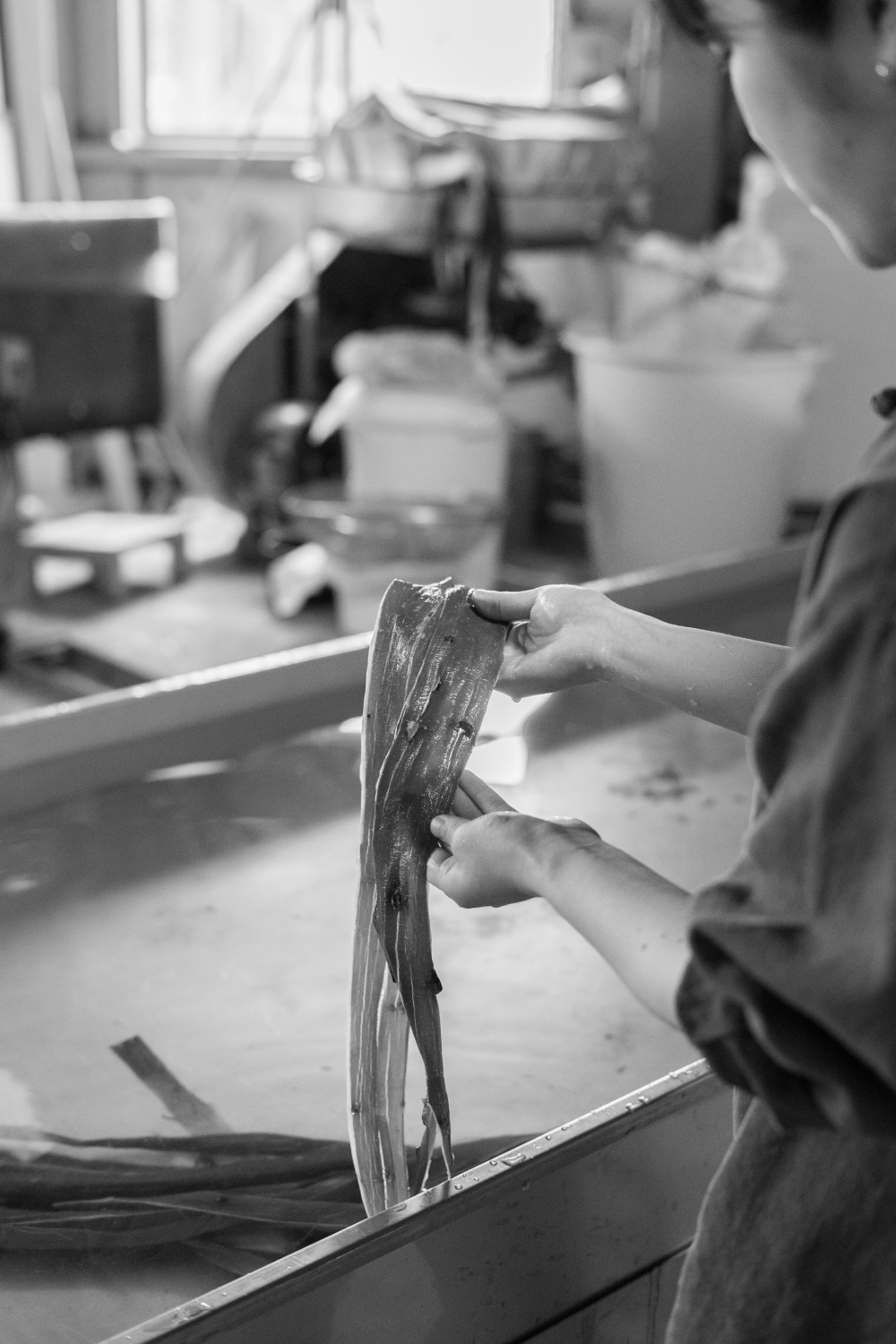
I can tell from things such as the sound when I mix the raw material in the water, whether the fibres have spread evenly when I lift the sheet, and the beauty of the layers of the sheets that have been formed and stacked one on top of another.
Read original Japanese
水の中で原料を混ぜた時の音、漉き上げた時繊維が均一に広がっているかや、積み重ねていった漉いた紙の層の美しさ、などでわかります。
Do you know yourself if a finished sheet is good or do you rely on another person’s opinion?
For me, I think good paper is paper in which the breathing or presence of the plant remains, and the fibres are evenly dispersed. However, depending on what kind of paper the person using it is looking for, what counts as good paper for that person changes. When I make paper in response to an order, I ask what it will be used for, and I think that if I can make paper that suits that purpose, then it is good paper.
Read original Japanese
自分の中では、植物の息遣いが残っていて、繊維が均一に分散されている紙がいい紙かなと思います。しかし、使う人がどういう紙を求めているかによって、その人にとっての良い紙は変わってきます。オーダーがあって紙を作る時には、使う目的を聞いて、それに合うように作れたら良い紙かなと思います。
You described good paper as paper in which “the breathing of the plant remains.” What does that mean to you?
For me, making paper in which “the breathing of the plant remains” is connected to thinking about sustainability and coexistence.
For example, I do not bleach the fibres when I make paper. This is partly because I want to reduce the environmental burden of the process, and partly because bleaching can damage the plant fibres more than necessary.
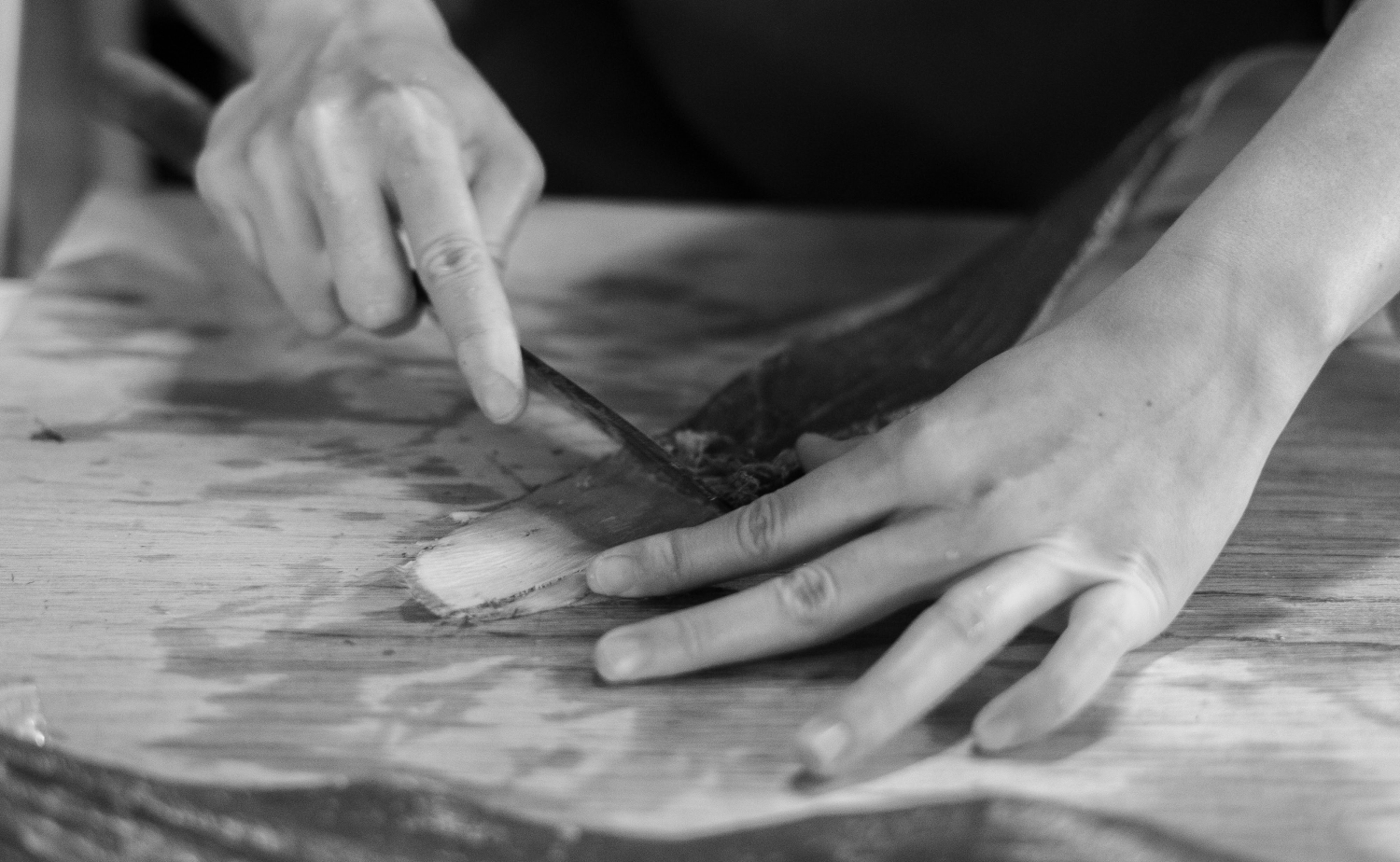
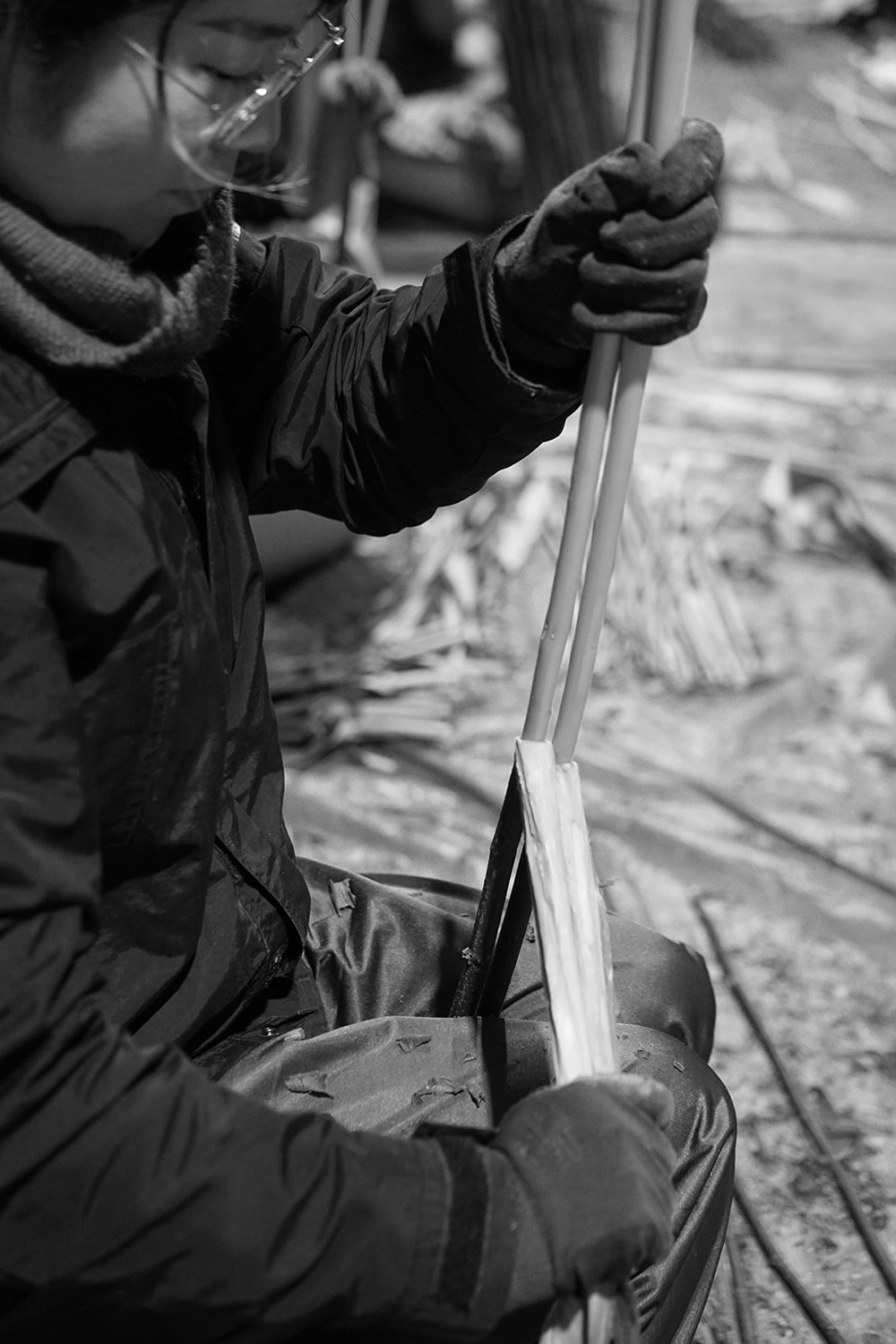
Instead of bleaching the fibres to make the paper white, I use a process called heguri (carefully shaving the bark with a knife to separate the white inner bark from the other layers), followed by chiritori (removing the harder fibres and impurities from the white bark by hand). It takes more time, but because the fibres have not been damaged by bleaching, I feel that the finished paper still retains “the breathing of the plant.”
I think it is important, when making something, not to think only about what is easiest or cheapest for people, but also to consider the effect on the environment.
Read original Japanese
植物の息遣いが残る紙を作ることは、持続可能な世界、共存について考えることです。 例えば、私は紙を作るときには漂白処理はしません。それは、作る過程での環境への負担を減らしたいのと、漂白処理をすることで植物の繊維が過度に傷められてしまうことを避けるためです。漂白して白さを出す代わりに、へぐりといって、樹皮を白い部分とそれ以外のところと包丁でそぎ分ける作業と、白皮から硬い繊維を手作業で取り除いていくちりとりという作業を行います。時間はかかりますが、漂白しない分、繊維が傷められていない「植物の息遣いが残った紙」になっていると感じます。ものを作る過程で、人間にとって何が楽で安くすむかだけではなく、環境のことも考えて作るのは大切なことだと思っています。
“Having to work according to the seasons makes me feel something important: that this world is not centred on human beings, and that I too am only one of the things created by God.”
Has your feeling and connection to nature changed at all through washi making?
For example, kōzo is harvested in winter, after its leaves have fallen. Papermaking is also mainly done during winter, when the raw material is less likely to spoil. Having to work according to the seasons makes me feel something important: that this world is not centred on human beings, and that I too am only one of the things created by God. So when I make paper, I try not to use excessive processing — such as boiling the raw material with chemicals that are too strong, or bleaching it — but instead to stay as close to the plant as possible, bring out its good qualities, and make things in a way that places less burden on nature.
Read original Japanese
たとえば、楮の収穫は、葉が落ちる冬に行います。紙漉きも、原料が腐りにくい冬場がメインです。季節に合わせて仕事をしないといけないということは、私に、この世界は人間中心ではなく、自分も神に造られたものの一つに過ぎない、という大切なことを感じさせてくれます。なので、紙を作る時には、過度な処理(原料を強過ぎる薬品で煮たり漂白する)などはせずに、なるべく植物に寄り添ってその良さを引き出し、自然に負荷の少ないものづくりをするように心がけています。
Do you think the practice has changed you as a person or influenced the way you see other parts of life?
I became a Christian in my second year of making washi. Now, my identity as a Christian is at the very foundation of who I am. This may not quite answer the question, but rather than feeling that making washi has influenced me, I feel that becoming a Christian brought changes to my life itself and to the way I hold my motivation toward making washi.
Read original Japanese
私は、和紙作りを始めて2年目にクリスチャンになりました。今ではクリスチャンであるというアイデンティティが一番の根幹にあります。質問の答えにならないかもしれませんが、和紙作りが影響を与えているというより、クリスチャンになったことが、私の、人生そのものや和紙づくりへのモチベーションの持ち方に変化を与えたと感じます。
What changed in your actual practice after you became Christian? Did it change the way you work, the decisions you make, or what you believe your responsibility is as a craftsperson?
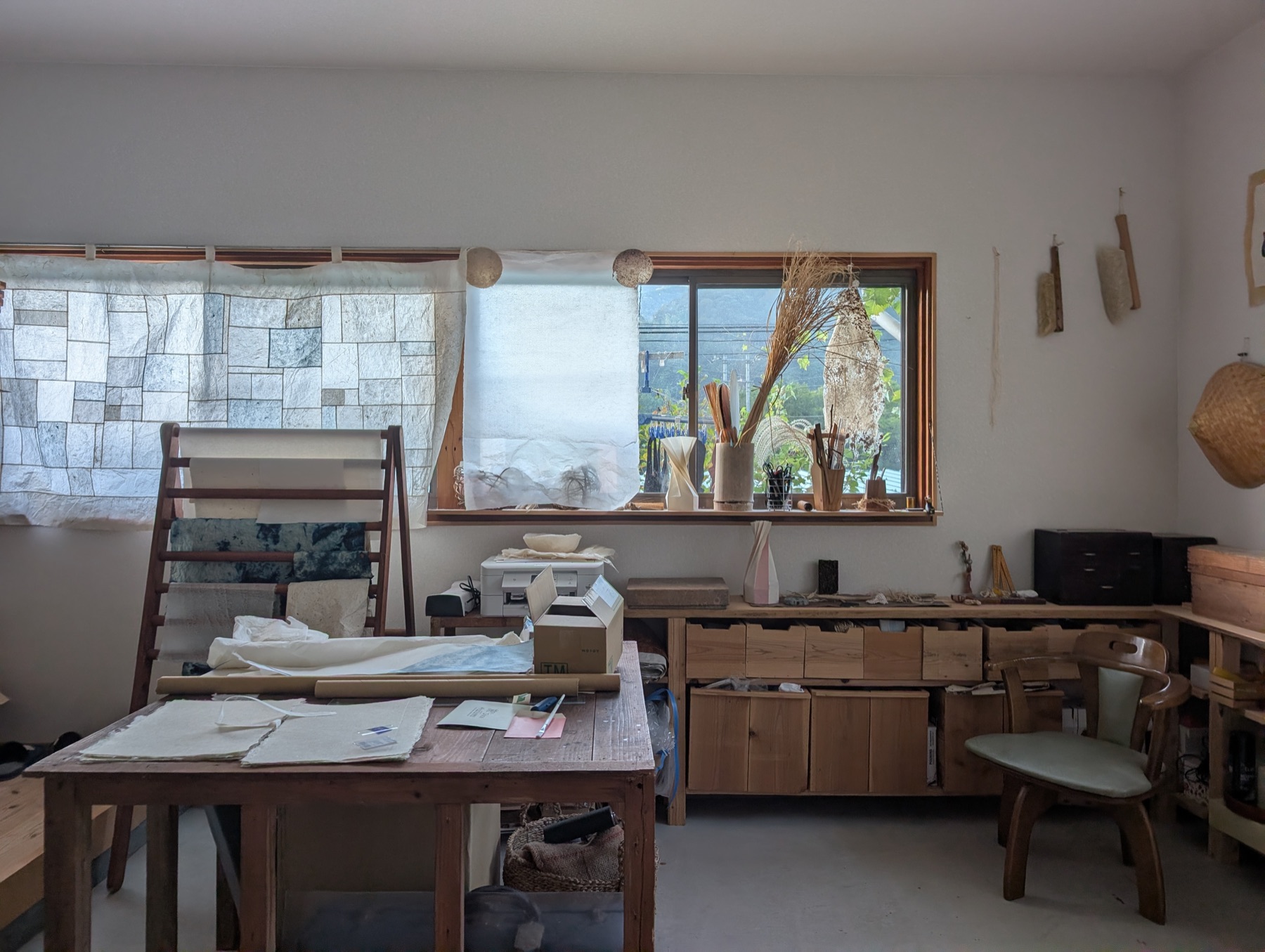
There are broadly two sides to my work. One is my work as a craftsperson, making paper as a material for other people to use. The other is more like the work of an artist, such as creating displays or making my own pieces. In the more freely creative side of my work, I began making pieces based on quotations from the Bible.
Even in my work as a craftsperson, I try to value and put into practice the words of the Bible that I read every day. For example, one passage that is important to the way I approach my work is Luke 16:10: “Whoever is faithful in very little is also faithful in much, and whoever is dishonest in very little is also dishonest in much.”
Read original Japanese
私の仕事には大きく分けて2種類あります。素材として求められる紙を作る職人仕事と、ディスプレイや自分の作品作りなどアーティストのような側面です。自由な創作活動の方では、聖書からの引用を元にした作品を作るようになりました。職人的な仕事をする上でも、日々読んでいる聖書の言葉は大切にして実践するようには心がけています。例えば、ルカの福音書16:10にある「最も小さなことに忠実な人は、大きなことにも忠実であり、最も小さなことに不忠実な人は、大きなことにも不忠実です。」は、仕事への向き合い方として大切にしている言葉の一つです。
What feels like the next level for you technically? Are there particular skills, materials, or methods you are still working to understand?
There are many things. For example, conservation paper — very thin kōzo paper of the kind that is also used in European museums — requires skill to make beautifully and in large quantities. My master is extremely good at this, and I admire that. I would like to practise it more myself as well.
Read original Japanese
いっぱいありますが...たとえば、ヨーロッパの美術館でも使われているような、修復紙(楮のとても薄い紙)は、きれいにたくさん作るのには技術が必要で、私の師匠はとてもそれが上手で憧れます。私も、それをもっと練習したいと思っています。
What feels like the next level for you creatively?
Until now, as a craftsperson, I have made paper as a material for people who use paper. That has helped me develop my skills and knowledge, and being able to make the paper someone is looking for is also a joy for me, so I want to continue doing that. At the same time, I am also interested in making works as a form of my own expression, and I would like to do more of that. Because I am a Christian, I would like to make works based on the Bible, and works through which my own faith can be communicated through paper.
I see my washi making as something that exists within my faith — as something I have been given as a way to express and communicate that faith.
Read original Japanese
私は今まで、職人として、紙を使う人に素材として紙を作ってきました。それは、私の技術と知識を発展させてくれているし、求められる紙を作れることは私にとって喜びでもあり、これからも続けていきたいと思っています。一方で、自分の表現として作品を作っていくことにも関心がありもっとやっていきたいと思っています。クリスチャンですから、聖書に基づいた作品や、自分の信仰が紙を通して伝わるような作品を作っていきたいです。信仰の中に和紙づくりが包括されている、信仰を伝えていく手段として与えられているという感覚です。